
Showing posts with label emotional health. Show all posts

Sunday, 10 May 2015

The Disastrous Effects of Negative Emotions on Our Body

Have you ever noticed more pains and aches following a traumatic event or after going through hardship? Did a painful loss stay with you as a niggling sensation in your body? Have you had tense shoulders ever since your difficult breakup? Or maybe you suffer from an ailment that you just can’t find an explanation for?
When we don’t want to listen to our emotions, they will find a different way to attract our attention. What we feel doesn’t just go away. Emotions can actually physically change us.
Our emotions and experiences are essentially energy and they can be stored in the cellular memory of our bodies. Does this ring true to you?

Negative Emotions and Physical Pain

Negative emotions can get trapped in the body and manifest as physical symptoms: pain, discomfort, tension. Not every physical ache necessarily has an underlying emotional component, but the connection is there and might be worth exploring. Is your body trying to tell you something by developing a tangible symptom that will make you stop and listen? The problem is that, despite all the signals, we often don’t listen and we forget to see beyond the physical.

Emotional Pain Chart

By mapping the body in this out-of-the-box way, emotional pain chart (see the chart below) provides a novel way to understand and interpret your body and mind. It suggests that every area of your body connects with a certain emotional state. Pain is a sign that something is out of balance or we have forgotten to address something.
We might all experience and deal with things in our lives in different ways, but there seems to be a universal way of reacting to similar emotions and patterns of thought. We all store specific emotions in specific parts of the body and can have specific health conditions attached to them. Your body has a way of telling you what is really going on deep inside of you, in your subconscious mind. Now, you just need to translate the messages.
By looking at the emotional pain chart, you might be able to understand your emotional pains and struggles better. Different feelings correspond to different parts of the human body.

A Few Examples

Some of the manifestations are quite symbolic and proverbial. For example:
  • Shoulder pain can be connected with a feeling of carrying a burden and having difficulty accepting and living your life in a joyous way.
  • Problems with knees can point to a certain level of inflexibility in life, an inability to bend; an expression of ego that won’t give in.
Also, some conditions and diseases have been linked to specific emotional states and ways of thinking. They are more likely to develop in people who follow similar patterns. For example, arthritic conditions have been associated with people who feel unloved or resentful, and inflammation can be a sign of fear.
So, next time you feel an unusual pain or stiffness in a part of your body, stop and think. Is this sensation an echo of something else? What is your body really trying to tell you?
Here is an emotional pain chart that demonstrate the relation between our negative emotions and pain in our body:
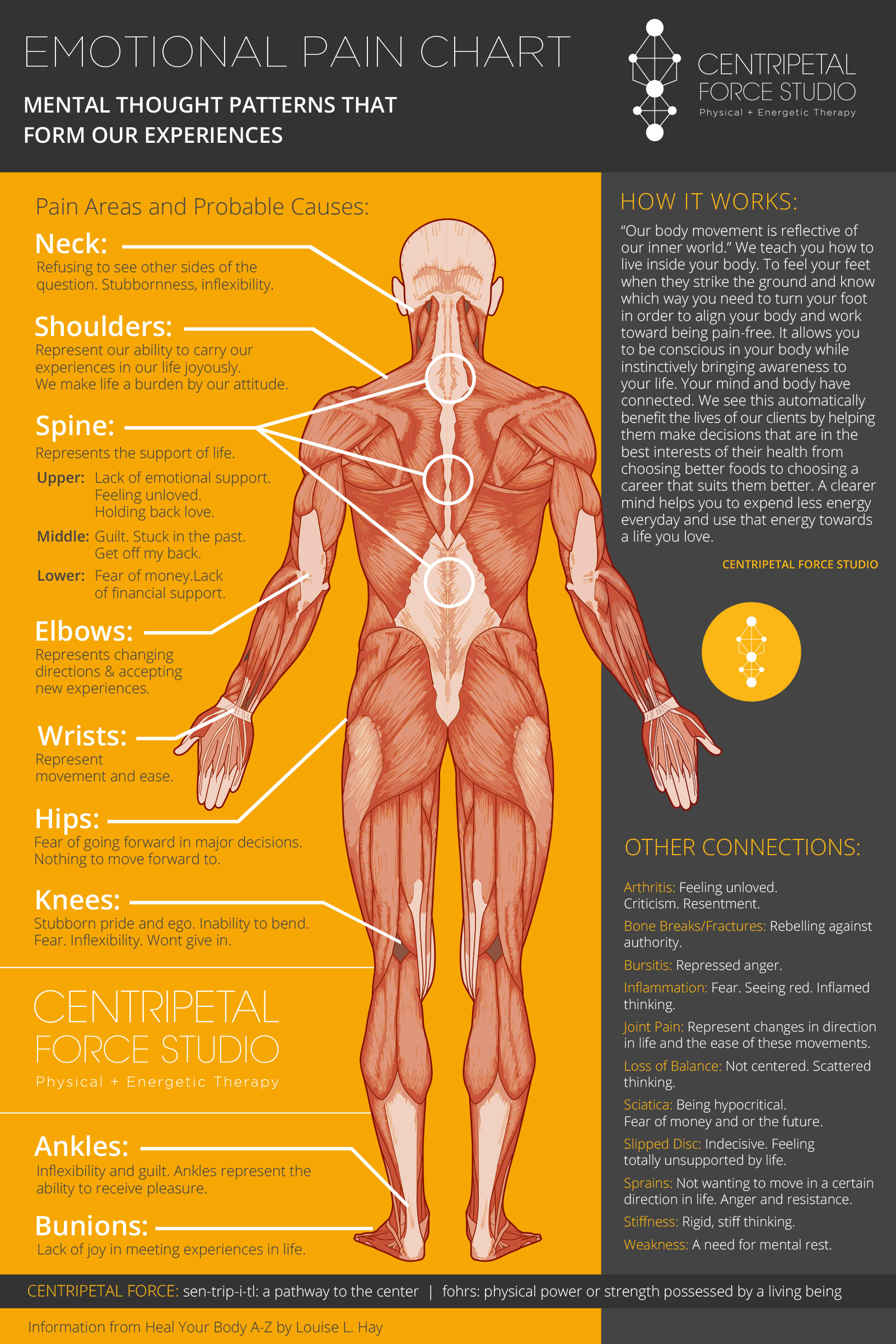
Emotional pain chart

Monday, 13 April 2015

How To Revitalize Your Life With Healthy Chakras

chakras
Our chakras are the body’s seven energy centers and some believe that we can use this energy to maintain a physically healthy lifestyle.
Keeping our chakras aligned and healthy requires certain exercises, like those of the five Tibetan rites. Essential oils are also closely linked to maintaining healthy chakras.
  Awareness of our seven chakras can result in lasting benefits and keep our minds open and calm, improving our physical and mental health.
To keep the chakras flowing and healthy, I’ll outline some benefiting practices to each chakra.

1. The Root Chakra

Responsible for basic creative and survival-based instincts, the root chakra requires you to listen to your intuitions above all else, including the desire to give in to needless wants.

2. The Sacral Chakra

There are many practices we can do to keep this center of our sexuality, creativity, and emotion aligned and healthy.
The key to keeping the sacral chakra strong, however, is balance. Some believe it to be the most sensitive chakra, and listening to intuition will help keep all areas, creatively, emotionally, sexually, or mentally, balanced.
The benefits of aligning our thoughts, actions, and emotions in a balanced life will enhance our creativity and enthusiasm.
3. The Navel Chakra
Sitting behind our belly button, the navel chakra suffers most when we eat unhealthy foods. Keeping a healthy diet will balance this chakra and in turn balance all the others.

4. The Heart Chakra

It’s no surprise that love is the strongest practice in keeping the heart chakra healthy.
Loving our inner self is the most important aspect of balancing this chakra. This will help us spiritually, emotionally, and physically.

5. The Throat Chakra

The throat chakra feeds our self-expression through speaking and an even deeper, spiritual expression of who we are.
To keep it balanced and healthy, we need to keep our physical throat healthy. Eating healthy foods and protecting against infections will benefit our chakra as well.

6. The Third Eye Chakra

For some, the third eye chakra helps perceive spirit, but it can also help us see a truer form of the world around us.
Meditation is a great practice to keep this chakra balanced and can also help to keep us energized through the day and feeling mentally healthy.

7. The Crown Chakra

The last chakra, the crown chakra, is the purest of all and keeping it aligned will help us express ourselves and our creativity every day.
The easiest way to keep it healthy is through an enlightening conversation with a friend. Other practices could include meditation, or even dancing as a form of spiritual attunement.
Following a healthy lifestyle can help maintain healthy chakras. Being open and willing to balance the chakras could benefit in a strong and flowing life.

Source: http://www.healthy-holistic-living.com/revitalize-your-life-with-chakras.html

Tuesday, 24 March 2015

Emotional health in childhood ‘is the key to future happiness’

LSE study says money, success and good grades are less important
Lord Richard Layard, who is emeritus professor of economics at the LSE.
 Lord Richard Layard, who is emeritus professor of economics at the LSE. 
Photograph: Linda Nylind/Observer

Mick Jagger famously couldn’t get it, but now economists think they know what’s required to get some satisfaction.
After investigating the factors in a person’s life that can best predict whether they will lead satisfied lives, a team headed by one of the UK’s foremost “happiness” experts, Professor Richard Layard, has come up with an answer that may prove controversial.
Layard and his colleagues at the Wellbeing research programme at the London School of Economics’ Centre for Economic Performance conclude that a child’s emotional health is far more important to their satisfaction levels as an adult than other factors, such as if they achieve academic success when young, or wealth when older. The authors explain that evaluating the quality of a child’s emotional health is based on analysing a range of internal factors in a person’s early life, including whether they endured unhappiness, sleeplessness, eating disorders, bedwetting, fearfulness or tiredness.
The academics claim that their study, What Predicts a Successful Life? A Life-course Model of Well-being, published in the latest edition of the Economic Journal, offers “a completely new perspective on which factors contribute most to a satisfying life”. The study claims to challenge “the basic assumption of educational policy in recent years – that academic achievement matters more than anything else”. This claim appears to be an implicit criticism of former education secretary Michael Gove, who instructed schools not to focus on “peripheral” issues such as children’s moral, social and cultural development in favour of academic excellence. Gove’s successor, Nicky Morgan, has pledged to reverse this approach.
Layard and his team analysed data from about 9,000 people who were born over a three-week period in 1970 and then tracked by the British Cohort Survey, a study that asks them to complete an extensive questionnaire about their lives every five to seven years. They were also asked to rate their satisfaction at key periods through their lives. The team then examined factors including their income, educational achievement, employment, whether they had been in trouble with the law, whether they were single, as well as their physical and emotional health – to gauge how significant these were in determining satisfaction. In addition, a range of factors that affect a child’s development – for example, intellectual performance, family socio-economic background and emotional health were also examined.
The findings are controversial. As one of Layard’s colleagues, Andrew E Clark, notes in an accompanying paper, the suggestion that “education and income are among the least important determinants of adult success, as measured by life satisfaction … risks provoking outrage among some.”Many people have assumed income is the most important factor in an adult’s life satisfaction. But the academics say their data makes clear this is far less important than emotional health – both in a child and in an adult. “Income only explains about 1% of the variation in life satisfaction among people in the UK – one sixth of the fraction explained by emotional health,” they note. Or, to put it another way, money really cannot buy you happiness.
But the economics of happiness or wellbeing is now a growing and respected discipline within economics that is starting to influence politicians.
David Cameron has stated: “It’s time we admitted that there’s more to life than money and it’s time we focused not just on GDP but on GWB – general well-being.”
The findings raise questions about the extent to which intervening in a child’s life will pay dividends later on.
“Child interventions can produce massive savings to public finances but these are often at a much later date,” the authors note. They conclude: “By far the most important predictor of adult life-satisfaction is emotional health, both in childhood and subsequently. We find that the intellectual performance of a child is the least important childhood predictor of life-satisfaction as an adult.”
http://www.theguardian.com/society/2014/nov/08/happiness-childhood-emotional-health-richard-layard