Showing posts with label dental care. Show all posts

Tuesday, 11 November 2014

Home Remedies For Yellow Teeth

 by Joe Martino

remedies_home_yellow_teeth

We live in an age that is almost ruled by coffee, which happens to be one of the biggest contributors to staining teeth and making them yellow. While step number one for whiter teeth would be to limit coffee intake, for some of us that may not be what we are ready for. So we’ve compiled a list of natural ways you can whiten your teeth at home.

Dental hygiene is important. It can be a contributing factor to many diseases in other areas of the body if not properly taken care of. One of the biggest ways we can damage our teeth is through acidic foods and drinks. In fact, a lot of times, the reason for yellow teeth is due to the consumption of an acidic diet that causes the enamel to wear away on teeth if they are not properly taken care of.

Disadvantages of Whitestrips & Bleaching

There are a number of whitening options one can explore via dentists, whitening professionals or the drugstore. These include bleaching trays, professional bleaching treatments and products like Whitestrips. There is no doubt that these products do work, but there are reported disadvantages to these options that don’t exist with doing the methods below correctly.

Often times the treatments above utilize harsh ingredients that can have quite powerful effect of gums and teeth. This can create sensitivity for both even after first use. For example, studies suggest that between 1/3 and 1/2 of all people who use Whitestrips will notice some degree of gum tissue irritation. [1] If you’ve tried these products in the past, you may have seen great results and had no irritation, but if you did experience irritation, try the options below for a more natural approach that is more in-line with a sustainable option as well.

Home Remedies For Yellow Teeth


1. Baking Soda


Baking soda is known as being one of the most effective options for whitening teeth. It’s why you see it added to a number of toothpaste brands. Simply add some to your toothbrush while it is fairly wet and then brush your teeth. Make sure the baking soda is wet enough and not dry as in a very dry state it can scratch your enamel. But once wet, it becomes soft and dissolves.  *I’ve personally used this method and found that it worked very well. Make sure you don’t use it dry! Also consider trying it as a mouthwash. Add more water to it and swish it around)

2. Strawberries


Strawberries are rich in vitamin C, which helps to make your teeth whiter. You can do this by crushing a few berries and then applying them to your teeth. Let it sit for about 3 -5 minutes and then rinse out your mouth well.

3. Lemon


Lemon has a solid bleaching power, many have used it for their hair but it can be used for the teeth as well. Squeeze lemon juice into a small bowl and add some sea salt to it. Grind it down to a pit so you produce a soft paste. Apply that to your teeth and let sit for 3 – 5 minutes. Rinse well. It’s important to rinse this well as you don’t want to let it sit over long periods of time and break away enamel.

4. Hydrogen Peroxide


Hydrogen Peroxide can be used quite effectively to whiten teeth. Due to its very mild bleaching properties, it can be put on the teeth topically to help remove stains. Create a 30/60 mix of hydrogen peroxide to water. Use it as a rinse for about 60 seconds and then spit it out. *I have also tried putting it directly on my teeth with a q-tip and letting it sit for 60 seconds. This worked well also.

5. Banana Peel


This one is controversial and I personally wouldn’t say this should be your go to option. Some health professionals say it works, while other say it doesn’t. In the end, the gritty surface, which is rich in magnesium and potassium, may polish teeth and helped remove some stains on the enamel. Results vary greatly and given the other options available, it’s probably best to stick with them, but this could work according to some. To do it, simply rub your teeth with the inside of a ripe banana peel for 2 – 5 minutes. Rinse when finished. Do this twice a day.

Sources

http://www.animated-teeth.com/whitening_strips/a4_teeth_whitening.htm

http://www.pantryspa.com/beauty-remedies/mouth-remedies/dr-oz-teeth-whitening-home-remedy-baking-soda-lemon-juice/

http://www.livestrong.com/article/15795-whiten-teeth-peroxide/
http://www.collective-evolution.com/2014/08/24/home-remedies-for-yellow-teeth/

Monday, 27 October 2014

Open Sesame! 10 Amazing Health Benefits Of This Super-Seed

Sayer Ji
Open Sesame! 10 Amazing Health Benefits Of This Super-SeedSesame (Sesamum indicum) is one of the oldest cultivated plants in the world, prized as an oilseed for at least 5,000 years.  While it is beginning to regain favor due to its exceptionally high calcium and magnesium content, few realize it is also one of the most potent medicinal foods still commonly consumed today.

In fact, its history as a medicine goes back 3600 years to Egyptian times where it was listed in the scrolls of the Ebers as a favored medicine.  Also, women in ancient Babylon were believed to use a mixture of honey and sesame seeds (halva) to prolong youth and beauty, and Roman soldiers ate the mixture for strength and energy.

In the past twenty years, a glut of scientific information has poured in demonstrating that sesame seed, and its components, have over three dozen documented therapeutic properties [see sesame research page].  Given these new revelations, it would seem that sesame would be just as at home in a medicine cabinet as it would be a kitchen cupboard.

Here are just 10 evidence-based medicinal properties of this food-medicine:

Diabetes: A study published in 2011 in the Clinical Journal of Nutrition showed that sesame oil improved the effectiveness of the oral antidiabetic drug glibenclamide in type 2 diabetic patients. [1]  Another study published in 2006 in the Journal of Medicinal Foods showed that the substitution of sesame seed oil as the sole edible oil lowers blood pressure and glucose in hypertensive diabetics. [2]

High Blood Pressure:  A study published in 2006 in the Yale Journal of Biological Medicine showed that sesame seed oil has a beneficial effect in hypertensive patients on either diuretics or beta-blockers. Substitution of all dietary oils with sesame oil brought down systolic and dystolic  blood pressure to normal, in addition to decreasing lipid peroxidation (bodily rancidity) and antioxidant status. [3] One of the compounds identified behind sesame seed's antihypertensive effects are peptides that act as angiotensin I-converting enzyme inhibitors.[4]
Gingivitis/Dental Plaque: Sesame seed oil has been used for oral health for thousands of years in the traditional Indian medical tradition known as Ayurveda in a process known as "oil pulling." It involves swishing sesame seed oil in the mouth for prolonged durations and has been said to prevent teeth decay, halitosis, bleeding gums, dry throat, and for strengthening the teeth, gums and jaw. Clinical research now confirms that it compares favorably to chemical mouthwash (chlorhexidine) in improving plaque-induced gingivitis,[5] and that it is capable of reducing Streptococcus mutans growth associated with oral plaque formation. [6]

Infant Health/Massage Oil:  A study published in the Indian Journal of Medical Research in 2000 showed that massaging infants with sesame oil improved both their growth and post-massage sleep, in comparison to control oils such as mineral oil.[7]
Multiple Sclerosis (MS): In the animal model of MS, also known as experimental autoimmune encephalomyelitis, sesame seed oil protects mice from developing the disease by reducing IFN-gamma secretion, a key factor in initiating autoimmune inflammation and injury in the nervous system.[8] It has also been research for its potential beneficial role in another neurodegenerative condition, Huntington's disease. [9]

Antibiotic-Induced Kidney Damage: Sesame seed oil protects against gentamicin-induced kidney damage in rats by reducing oxidative damage caused by the antibiotic.[10]
Atherosclerosis: Sesame seed oil prevents the formation of atherosclerotic lesions in mice fed an atherogenic diet.[11]  The antioxidant and anti-inflammatory lignan found within sesame seeds known as sesamol has been identified to be partially responsible for its anti-atherogenic properties. In fact, sesamol has been shown to possess over two dozen beneficial pharmacologically active properties, many of which may contribute to improving cardiovascular health.


Disclaimer: This article is not intended to provide medical advice, diagnosis or treatment.


How much to use ?

I would not roast it unless it has to be used roasted and I did not read any comparative studies too. Heat can make the fat worse, especially omega 6, and makes enzymes useless(enzymes may not be much important in this food) but it may also eliminate antinutrients. Nuts and seeds are suggested to be soaked in water to get rid of antinutrients but it's not much practicable with sesame.

My question is, how much do you use and what is the amount you use based on ? Too much omega 6 may bring one closer to all inflammatory diseases:

http://atozhealthtopics.blogspot.com/2011/11/list-of-inflammatory-diseases.html

Selection between healthy foods that are high in omega 6 contradicts me. I've let myself eat a diet with high(though lower than most people's diets) omega 6 to omega 3 ratio for some time and I want to lower this ratio in my diet. Getting back to sesame, I will make a selection between sesame and eggs because they are both vitamin T and also omega 6 sources. Sesame is a source of sesamol and sesamin, and eggs are one of the best sources of phosphatidyl choline. Lignans are better obtained from high omega 3 source flax seeds, I think and other choline sources are either unpleasant to eat to me(organ meats, fat trimmed kidneys are best choline sources per calories) or inconvenient to eat enough to get enough choline(vegetables, cauliflowers are best), therefore I will try to choose eggs usually.

So which high omega 6 source foods and how much do the writers here suggest in general ? I do not know and I hope to read on this.
http://www.greenmedinfo.com/blog/open-sesame-10-amazing-health-benefits-super-seed

Monday, 25 August 2014

New teeth grown from urine - study

By James Gallagher
Teeth

Scientists have grown rudimentary teeth out of the most unlikely of sources, human urine.
The results, published in Cell Regeneration Journal, showed that urine could be used as a source of stem cells that in turn could be grown into tiny tooth-like structures.
The team from China hopes the technique could be developed into a way of replacing lost teeth.
Other stem cell researchers caution that that goal faces many challenges.
Teams of researchers around the world are looking for ways of growing new teeth to replace those lost with age and poor dental hygiene.
Stem cells - the master cells which can grow into any type of tissue - are a popular area of research.
The group at the Guangzhou Institutes of Biomedicine and Health used urine as the starting point.
Cells which are normally passed from the body, such as those from the lining of the body's waterworks, are harvested in the laboratory. These collected cells are then coaxed into becoming stem cells.
A mix of these cells and other material from a mouse was implanted into the animals.

Start Quote

You just wouldn't do it in this way”
Prof Chris MasonUniversity College London
The researchers said that after three weeks the bundle of cells started to resemble a tooth: "The tooth-like structure contained dental pulp, dentin, enamel space and enamel organ."
However, the "teeth" were not as hard as natural teeth.
This piece of research is not immediately going to lead to new options for the dentist, but the researchers say it could lead to further studies towards "the final dream of total regeneration of human teeth for clinical therapy".
'Worst source'
Prof Chris Mason, a stem cell scientist at University College London, said urine was a poor starting point.
"It is probably one of the worst sources, there are very few cells in the first place and the efficiency of turning them into stem cells is very low.
"You just wouldn't do it in this way."
He also warned that the risk of contamination, such as through bacteria, was much higher than with other sources of cells.
Prof Mason added: "The big challenge here is the teeth have got a pulp with nerve and blood vessels which have to make sure they integrate to get permanent teeth."
http://www.bbc.co.uk/news/health-23492425


No more fillings as dentists reveal new tooth decay 

treatment

Scientists in London develop pain-free filling that allows teeth to repair themselves without drilling or injections

Dentist
he new treatment, Electrically Accelerated and Enhanced Remineralisation (EAER), could be available within three years. Photograph: Hermes Morrison 2/Alamy
Scientists have developed a new pain-free filling that allows cavities to be repaired without drilling or injections.
The tooth-rebuilding technique developed at King's College London does away with fillings and instead encourages teeth to repair themselves.
Tooth decay is normally removed by drilling, after which the cavity is filled with a material such as amalgam or composite resin.
The new treatment, called Electrically Accelerated and Enhanced Remineralisation (EAER), accelerates the natural movement of calcium and phosphate minerals into the damaged tooth.
A two-step process first prepares the damaged area of enamel, then uses a tiny electric current to push minerals into the repair site. It could be available within three years.
Professor Nigel Pitts, from King's College London's Dental Institute, said: "The way we treat teeth today is not ideal. When we repair a tooth by putting in a filling, that tooth enters a cycle of drilling and refilling as, ultimately, each 'repair' fails.
"Not only is our device kinder to the patient and better for their teeth, but it's expected to be at least as cost-effective as current dental treatments. Along with fighting tooth decay, our device can also be used to whiten teeth."
A spinout company, Reminova, has been set up to commercialise the research. Based in Perth, Scotland, it is in the process of seeking private investment to develop EAER.
The company is the first to emerge from the King's College London Dental Innovation and Translation Centre, which was set up in January to take novel technologies and turn them into new products and practices.
King's College is a participant in MedCity, a project launched by the London mayor, Boris Johnson, to promote entrepreneurship in the London-Oxford-Cambridge life sciences "golden triangle".
The chairman of MedCity, Kit Malthouse, said: "It's brilliant to see the really creative research taking place at King's making its way out of the lab so quickly and being turned into a new device that has the potential to make a real difference to the dental health and patient experience of people with tooth decay."

Monday, 14 July 2014

Forget Fluoride! Make Your Own Toothpaste with These 3 Easy Recipes

Forget Fluoride! Make Your Own Toothpaste with These 3 Easy Recipes

make your own home made toothpaste - forget fluoride
By April McCarthy
Ingredients found in conventional toothpastes — including sodium fluoride, synthetic dyes derived from petroleum or coal tar, sodium hydroxide (also known as lye or caustic soda), sodium lauryl sulfate, titanium dioxide, artificial sweeteners, and triclosan — might make us think twice about the products we employ for the sake of our teeth.
Of course, we’re not actively swallowing the stuff, but the gums absorb it, and it’s unavoidable that a bit will slink down the gullet from time to time. And given that most of us brush our teeth over 700 times a year, there’s no shortage of opportunity to ingest ingredients better left in the lab. It’s time to get crafty and create your own toothpaste that will leave your breath minty clean.
The most controversial of all the ingredients is fluoride. Although fluoride has been proven to cause neurotoxicity, very little published research has elaborated on acute fluoride poisoning and neurotoxicity in adults and children.
 A study published in Neurologia showed that the prolonged ingestion of fluoride may cause significant damage to health and particularly to the nervous system. A report in a peer-reviewed open access journal published by the National Institute of Environmental Health Sciences performed a systematic review and meta-analysis of published studies to investigate the effects of increased fluoride exposure and delayed neurobehavioral development. The results confirmed toxicity to the brain.
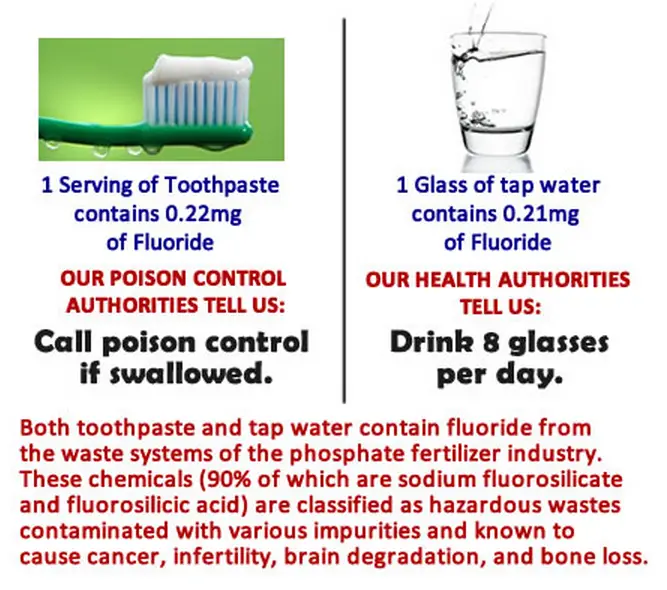
Most people are quite shocked when they review the following info-graphic on fluoride levels in water and toothpaste:
Fluoride Dangers
Thankfully you can eliminate fluoride from your dental routine by making your own natural and effective toothpaste.

Make Your Own Toothpaste

Recipe #1 -
  • 1 teaspoon baking soda
  • 1/2 teaspoon sea salt, finely ground
  • 10 drops peppermint, clove, or citrus pure essential oil
  • few drops of water
Recipe #2 -
  • 6 teaspoon baking soda
  • 1/4 teaspoon hydrogen peroxide
  • 2 tablespoons coconut oil (must be liquid)
  • 10 drops peppermint, clove, or citrus pure essential oil
Recipe #3 -
  • 5 parts Calcium Magnesium Powder
  • 2 parts Baking Soda
  • 3-5 parts coconut oil to get desired texture
  • Optional ingredients: Essential oils for flavor (mint, cinnamon, and orange are all good), Grapefruit Seed Extract, Myrrh and Trace Minerals
  • 3 parts Xylitol powder (alcohol sugar) – this ingredient is not completely necessary, but just keeps it from tasting bitter
Instructions:
To keep things simple, just use a teaspoon or tablespoon, depending on the size batch you are making.
1. Mix all powdered ingredients well in a bowl. If you are starting with tablets, powder them in a food processor. If you are starting with capsules, dump them out into the bowl.
2. Add oil one part at a time until you get desired consistency.
3. Add any optional ingredients, including Essential Oils for flavor.
4. Store in small container like 1/2 pint glass jar. To use, either dip clean toothbrush into it, or use popsicle stick or spoon to put on toothbrush.