Showing posts with label fluoride. Show all posts

Saturday, 30 September 2017

6 Ways To Detox Fluoride – A Known Neurotoxin – From Your Body

Sodium fluoride is classified as a neurotoxin - in the same category as arsenic, lead, and mercury, but it’s still prevalent in the United States’ water supply. Here are six ways to detox the substance from your body.
For years, health experts have been debating about whether or not sodium fluoride is toxic to the human body. Small amounts applied topically may prevent tooth decay, but there is little evidence suggesting that fluoride improves health when it is ingested.
In fact, according to the world’s oldest and most prestigious medical journal, The Lancet, the additive is actually a neurotoxin and is classified in the same category as arsenic, lead, and mercury. Because it is commonly ingested through fluoridated water, certain foods, and commercial toothpastes, researchers believe that the additive is contributing to a worldwide “pandemic of developmental neurotoxicity” that results in disabilities such as attention-deficit hyperactivity disorder, dyslexia, and other cognitive impairments.
The report coincides with 2013 findings by a Harvard University meta-analysis which was funded by the National Institutes of Health. The researchers concluded that children in areas with highly fluoridated water have “significantly lower’ IQ scores than those who live in areas with low amounts of fluoride in their water supply. In addition, the Harvard website states that “extremely high levels of fluoride are known to cause neurotoxicity in adults, and negative impacts on memory and learning have been reported in rodent studies.” In addition, “little is known about the substance’s impact on children’s neurodevelopment.”
Despite these findings, fluoride is still added to approximately 60% of the United States’ water supply. This is especially concerning, considering that sodium fluoride was once used as rat poison.
Because the cumulative toxin accumulates in the human body and can manifest in problems over time, including dental fluorosis – or far worse health issues, it’s important every individual follows the steps below to eliminate the additive from their body.
Note: You might experience detox symptoms at first – such as headaches, sluggishness, or aches and pains, but this is a sign foreign agents are leaving your body. Drink plenty of water and follow the six steps listed below to naturally eliminate fluoride from your system.

1) Get Adequate Iodine

Iodine is an important element for the normal metabolism of cells, especially thyroid hormones. It pushes the fluoride from your body via urine. Some good sources of iodine include seaweed (nori, dulse, wakame, etc…), cranberries, organic yogurt, potatoes, organic strawberries, and organic navy beans.

2) Consume More Boron

Boron is a natural element that helps flush fluoride from your body. Boron-rich foods include most nuts, dates, prunes, honey, broccoli, bananas, and avocado.

3) Eat Some Tamarind

This African fruit and spice is used extensively in Ayurvedic medicine. It can be used in a tincture or tea to cleanse the body of fluoride.

4) Increase Magnesium/Calcium Intake

Most people are deficient in magnesium because the soils have been depleted of this mineral through modern agricultural methods. It plays an important role, however, in the metabolism and synthesis of nutrients within your cells. It also inhibits the absorption of fluoride into your cells. Along with magnesium, calcium seems to help attract fluoride away from bones and teeth, allowing the body to eliminate it.
Both should be taken together, and this can easily be accomplished by consuming dark leafy greens, nuts, seeds, fish, beans, whole grains, avocados, organic yogurt, bananas, dried fruit, and dark chocolate.

5) General Liver Cleanse

The most important step to detoxify from excess fluoride may be to cleanse your liver. The liver is responsible for over 400 functions in the body, and when it gets overburdened, a number of symptoms may manifest. Because fluoride isn’t a product found naturally in the body, some sources claim that it may get stuck in the liver.
If you drink lemon water upon rising and eat liver-friendly foods, such as garlic, turmeric, lemons, limes, and avocado, your body will have an easier time removing heavy metals and toxins.

6) Sit In A Sauna

Saunas are great for ridding your body of toxins, as they inspire the body to sweat them out. The penetrating heat feels good, as well. Just be sure to drink plenty of water before and after to prevent dehydration. If you have any medical conditions, consult your healthcare provider first.
Credit: AmbitiousKitchen
By adopting a wholesome, plant-based diet, getting plenty of exercise, receiving 15-20 minutes of sunlight per day, thinking positive thoughts, and taking time off to keep your stress levels in check, you’ll find that you feel better and have more energy than before. These additional tips will improve your body’s ability to detox fluoride and other toxins from your system, as well.
What are your thoughts? Please comment below and share this news!
This article (6 Ways To Detox Fluoride – A Known Neurotoxin – From Your Body) is free and open source. You have permission to republish this article under a Creative Commons license with attribution to the author and TrueActivist.com

Click Here For More Articles

Don't forget to opt-in to Our Healthy Living Society and get 3 free gifts while receiving the latest information on health, well-being and groundbreaking news about natural nutrition.

Thursday, 11 December 2014

Sunday, 21 September 2014

This Infographic Shows What Soda Does to Your Body

Just one sip of soda can have health consequences on your body. This infographic explains the dangers of what happens when soda enters your body.


11 Toxic Chemicals Affecting Brain Development In Children
Alice G. Walton

The list of chemicals that can affect brain development in children has grown. In a study out today in The Lancet Neurology, researchers outline new chemicals that may be contributing to what they dub the “global, silent pandemic of neurodevelopmental toxicity.” In 2006, the team had released a list of five neurotoxins that may contribute to everything from cognitive deficits to attention problems. Now that list is expanded, based on new research that has since accumulated on chemicals linked to developmental disorders in children. Today, they outline six more.
“The greatest concern is the large numbers of children who are affected by toxic damage to brain development in the absence of a formal diagnosis,” said study author Philippe Grandjean, of the Harvard School of Public Health. “They suffer reduced attention span, delayed development, and poor school performance. Industrial chemicals are now emerging as likely causes.”
Neurobehavioral problems, like autism, ADHD, and dyslexia, affect about 10-15% of kids born today, the authors say. Genes play a large role in some of these disorders – but not that large. Only about 30-40% of the cases of the disorders can be accounted for by genes alone, so environment must make up the other part. Outlining those compounds can be difficult, but the research is mounting, and pointing to a growing list of chemicals that we should avoid.
Because of the frequency with which these chemicals are present in our everyday lives – even banned ones – and the rising rates of developmental disorders in children, the authors say that urgent change should take place: “A new framework of action is needed.”
Here are the 11 chemicals for which there is strong evidence of connection to neurodevelopmental disorders in children:
Lead–This is one of the most extensively researched compounds in terms of neurodevelopment, and has been consistently linked to serious deficits, including low IQ. Its effects seem to be permanent, leading to the conclusion that there is no safe level of exposure.
Methylmercury–Affecting the neurological development of the fetus,exposure often comes from maternal intake of fish containing high levels of mercury, according to the World Health Organization and the EPA.
Polychlorinated biphenyls (PCB) – This family of chemicals has routinely been associated with reduced cognitive function in infancy and childhood. It is often present in foods, particularly fish, and can be passed along in breast milk.
Arsenic – When absorbed through drinking water, this chemical has been linked to reduced cognitive function in schoolchildren. Follow-up studies from the Morinaga milk poisoning incident have linked it to neurological disease in adulthood.
Toluene – Used as a solvent, maternal exposure has been linked to brain development problems and attention deficit in the child, according to the EPA and OSHA.
Manganese – In the drinking water in Bangladesh, for example, this chemical has been linked to lower scores in math, diminished intellectual function, and ADHD.
Fluoride – Higher levels of this chemical has been connected with a 7-point decrease in IQ in children.
Chlorpyrifos and DDT (pesticides) – Linked to structural abnormalities of the brain and neurodevelopmental problems that persist up to age 7. These pesticides are banned in many parts of the world (U.S. included), but still used in many lower-income countries. They have recently been linked to Alzheimer’s disease as well.
Tetrachloroethylene (AKAperchlorethylene)– These solvents have been linked to hyperactivity and aggressive behavior, and increased risk of psychiatric diagnosis. Mothers in certain professional roles, like nurse, chemist, cleaner, hairdresser, and beautician had higher levels of exposure.
The polybrominateddiphenyl ethers – These flame retardants are banned now, but believed to be neurotoxins. Prenatal exposure has been linked to neurodevelopmental disorders in the child.
Two more compounds of concern are bisphenol A (BPA), a common plastics additive, and phthalate, found in many cosmetics. BPA is an endocrine (hormone) disruptor, and, strongly suspected to affect neurodevelopment in children, it has been banned in baby bottles and sippy cups. Phthalates, which are common in personal products like nail polish and hair spray, have been routinely linked to shortened attention span and impaired social interactions in children.

The developing human brain is incredibly vulnerable to chemical exposures, both in utero and in early childhood, and these changes can be lifelong. “During these sensitive life stages,” say the authors, “chemicals can cause permanent brain injury at low levels of exposure that would have little or no adverse effect in an adult.”
The neurotoxin “pandemic” is disturbing enough that the authors strongly recommend having mandatory tests for chemicals, which many have been arguing for years. One common complaint has been that when one compound does finally become banned, another equally toxic and often untested chemical may take its place. More rigorous testing, though complicated to carry out, might address this major issue.
“The problem is international in scope,” says Grandjean,“and the solution must therefore also be international. We have the methods in place to test industrial chemicals for harmful effects on children’s brain development—now is the time to make that testing mandatory.”
Avoiding these chemicals can be difficult, because they are so prevalent, and present in food, cosmetics, receipt papers, and containers. 
But reading labels and avoiding certain products is a start.

Tuesday, 5 August 2014

The Spice That Prevents Fluoride From Destroying Your Brain

http://themindunleashed.org/wp-content/uploads/2014/04/spiceeee.jpg

Fluoride is found everywhere today, from antibiotics to drinking water, no stick pans to toothpaste, making exposure inevitable. All the more reason why new research proving this common spice can prevent fluoride damage is so promising!
Fluoride’s neurotoxicity has been the subject of academic debate for decades, and now a matter of increasingly impassioned controversy among the general public, as well. From ‘conspiracy theories’ about it being first used in drinking water in Russian and Nazi concentration camps to chemically lobotomize captives, to its now well-known IQ lowering properties, to its ability to enhance the calcification of the pineal gland – the traditional ‘seat of the soul’ – many around the world, and increasingly in the heavily fluoridated regions of the United States, are starting to organize at the local and statewide level to oust this ubiquitous toxicant from municipal drinking water.
Now, a new study published in the Pharmacognosy Magazine titled, “Curcumin attenuates neurotoxicity induced by fluoride: An in vivo evidence,” adds experimental support to the suspicion that fluoride is indeed a brain-damaging substance, also revealing that a natural spice-derived protective agent against the various health effects associated with this compound is available.
The study was authored by researchers from the Department of Zoology, University College of Science, M.L. Sukhadia University, Udaipur, India, who have spent the past decade investigating the mechanisms through which fluoride induces severe neurodegenerative changes in the mammalian brain, particularly in cells of the hippocampus and cerebral cortex.[i] [ii]
The study opens by describing the historical backdrop for concern about fluoride’s significant and wide ranging toxicity:
“Fluoride (F) is probably the first inorganic ion which drew attention of the scientific world for its toxic effects and now the F toxicity through drinking water is well-recognized as a global problem. Health effect reports on F exposure also include various cancers, adverse reproductive activities, cardiovascular, and neurological diseases.[1,2]“
The study focused on fluoride induced neurotoxicity, identifying excitoxicity (stimulation of the neuron to the point of death) and oxidative stress as the two main drivers of neurodegeneration.  It has been observed that subjects with the condition known as fluorosis, a mottling of tooth enamel caused by excessive exposure to fluoride during tooth development, also have neurodegenerative changes associated with a form of oxidative stress known as lipid peroxidation (rancidity). Excess lipid peroxidation in the brain can lead to a decrease in total brain phospholipid content. Owing to these well-known mechanisms of fluoride associated neurotoxicity and neurodegeneration, the researchers identified the primary polyphenol in the spice turmeric — known as curcumin – as an ideal agent worth testing as a neuroprotective substance.  Previous research on curcumin indicates that it is capable of activing as an antioxidant in 3 distinct ways by protecting against: 1) singlet oxygen 2) hyrodxyl radicals and 3) superoxide radical damage. Also, curcumin appears to raise endogenous glutathione production in the brain, a major antioxidant defense system.
In order to assess the neurotoxic effects of fluoride and prove curcumin’s protective role against it, researchers randomly divided up mice into four groups, for 30 days:
  1. Control (no fluoride)
  2. Fluoride (120 ppm): fluoride was given in distilled water drinking water without restriction.
  3. Fluoride (120 ppm/30 mg/kg body weight) + Curcumin: Oral dose of curcumin dissolved in olive oil along with fluoride in drinking water
  4. Curcumin: (30 mg/kg body weight)
In order to ascertain the effect of treatment, the researchers measured the malondialdehyde (MDA) content in the brains of the different treated mice. MDA is a well-known marker of oxidative stress/damage.
As was expected, the fluoride (F) only treatment group showed significantly elevated MDA levels vs. the non-fluoride treated control. The F + Curcumin group saw reduced MDA levels vs. the fluoride only group, demonstrating curcumin’s neuroprotective activity against fluoride associated neurotoxicity.
The study concluded,
“Our study thus demonstrate that daily single dose of 120 ppm F result in highly significant increases in the LPO [lipid peroxidation, i.e. brain rancidity] as well as neurodegenerative changes in neuron cell bodies of selected hippocampal regions. Supplementation with curcumin significantly reduce the toxic effect of F to near normal level by augmenting the antioxidant defense through its scavenging property and provide an evidence of having therapeutic role against oxidative stress mediated neurodegeneration.”

DISCUSSION

This is far from the first study to demonstrate curcumin’s remarkable brain-saving properties. From the perspective of the primary research alone, there are over two hundred peer-reviewed published studies indicating that curcumin is a neuroprotective agent. On our own turmeric database we have 115 articles proving this statement: Turmeric Protects The Brain.  We have also featured studies on turmeric’s ability to protect and restore the brain:
  • How Turmeric Can Save the Aging Brain From Dementia and Premature Death
  • Turmeric Produces ‘Remarkable’ Recovery in Alzheimer’s Patients
Considering the many chemical insults we face on a daily basis in the post-industrial world, turmeric may very well be the world’s most important herb, with over 600 evidence-based health applications.

[i] Bhatnagar M, Rao P, Saxena A, Bhatnagar R, Meena P, Barbar S. Biochemical changes in brain and other tissues of young adult female mice from fluoride in their drinking water. Fluoride. 2006;39:280–4. [Ref list]
[ii] Bhatnagar M, Sukhwal P, Suhalka P, Jain A, Joshi C, Sharma D. Effects of fluoride in drinking water on NADPH-diaphorase neurons in the forebrain of mice: A possible mechanism of fluoride neurotoxicity. Fluoride. 2011;44:195–9. [Ref list]

ABOUT THE AUTHOR

Sayer Ji is the founder of GreenMedInfo.com, an author, educator, Steering Committee Member of the Global GMO Free Coalition (GGFC), and an advisory board member of the National Health Federation.
He founded Greenmedinfo.com in 2008 in order to provide the world an open access, evidence-based resource supporting natural and integrative modalities. It is widely recognized as the most widely referenced health resource of its kind.
Disclaimer: This article is not intended to provide medical advice, diagnosis or treatment.

Monday, 14 July 2014

Forget Fluoride! Make Your Own Toothpaste with These 3 Easy Recipes

Forget Fluoride! Make Your Own Toothpaste with These 3 Easy Recipes

make your own home made toothpaste - forget fluoride
By April McCarthy
Ingredients found in conventional toothpastes — including sodium fluoride, synthetic dyes derived from petroleum or coal tar, sodium hydroxide (also known as lye or caustic soda), sodium lauryl sulfate, titanium dioxide, artificial sweeteners, and triclosan — might make us think twice about the products we employ for the sake of our teeth.
Of course, we’re not actively swallowing the stuff, but the gums absorb it, and it’s unavoidable that a bit will slink down the gullet from time to time. And given that most of us brush our teeth over 700 times a year, there’s no shortage of opportunity to ingest ingredients better left in the lab. It’s time to get crafty and create your own toothpaste that will leave your breath minty clean.
The most controversial of all the ingredients is fluoride. Although fluoride has been proven to cause neurotoxicity, very little published research has elaborated on acute fluoride poisoning and neurotoxicity in adults and children.
 A study published in Neurologia showed that the prolonged ingestion of fluoride may cause significant damage to health and particularly to the nervous system. A report in a peer-reviewed open access journal published by the National Institute of Environmental Health Sciences performed a systematic review and meta-analysis of published studies to investigate the effects of increased fluoride exposure and delayed neurobehavioral development. The results confirmed toxicity to the brain.
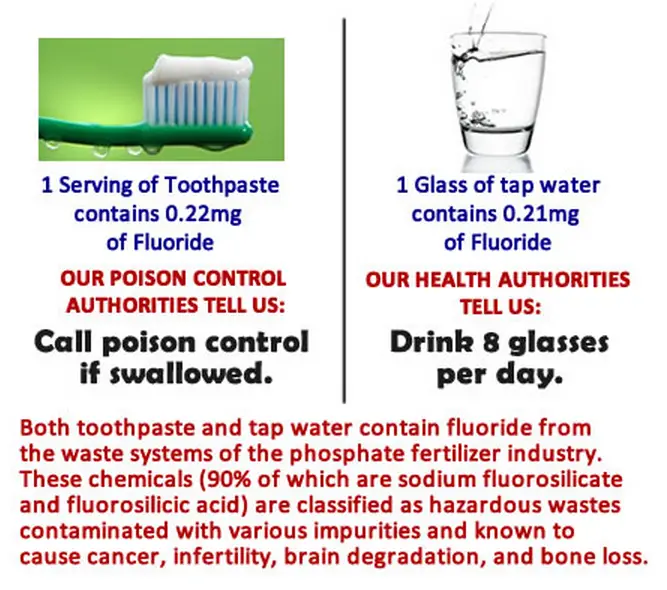
Most people are quite shocked when they review the following info-graphic on fluoride levels in water and toothpaste:
Fluoride Dangers
Thankfully you can eliminate fluoride from your dental routine by making your own natural and effective toothpaste.

Make Your Own Toothpaste

Recipe #1 -
  • 1 teaspoon baking soda
  • 1/2 teaspoon sea salt, finely ground
  • 10 drops peppermint, clove, or citrus pure essential oil
  • few drops of water
Recipe #2 -
  • 6 teaspoon baking soda
  • 1/4 teaspoon hydrogen peroxide
  • 2 tablespoons coconut oil (must be liquid)
  • 10 drops peppermint, clove, or citrus pure essential oil
Recipe #3 -
  • 5 parts Calcium Magnesium Powder
  • 2 parts Baking Soda
  • 3-5 parts coconut oil to get desired texture
  • Optional ingredients: Essential oils for flavor (mint, cinnamon, and orange are all good), Grapefruit Seed Extract, Myrrh and Trace Minerals
  • 3 parts Xylitol powder (alcohol sugar) – this ingredient is not completely necessary, but just keeps it from tasting bitter
Instructions:
To keep things simple, just use a teaspoon or tablespoon, depending on the size batch you are making.
1. Mix all powdered ingredients well in a bowl. If you are starting with tablets, powder them in a food processor. If you are starting with capsules, dump them out into the bowl.
2. Add oil one part at a time until you get desired consistency.
3. Add any optional ingredients, including Essential Oils for flavor.
4. Store in small container like 1/2 pint glass jar. To use, either dip clean toothbrush into it, or use popsicle stick or spoon to put on toothbrush.