Showing posts with label Healthy Foods. Show all posts

Sunday, 10 May 2015

Healthy Oats Breakfast Recipes

Over the past few decades oats have become a very popular “health food”. Oats are loaded in dietary fiber and have healthy cholesterol-lowering properties.
Oats are rich in a specific type of fiber called beta-glucan. This particular type of fiber is known to help lower levels of bad cholesterol. One cup (81g) of dry oats contains 8.2 grams of fiber, the recommended daily intake of fiber is 25g for women and 38g for men. One cup of dry oats (81g) contains approximately 307 calories.
For those who are looking for new and tasty recipes with Oats, here are 3 best Oats recipes in Indian style. Oats prevent obesity and all the recipes are easy to make. Enjoy the India twist:
1. Oats Instant Idli:
oats idli
Ingredients:
  • 2 cups oats (make a fine powder in a blender)
  • 1 cup sooji/rava/semolina
  • a pinch of baking soda
  • 1 cup of curd or buttermilk
  • salt as required
  • water as required
Vegetables:
  • a small bowl of grated carrot
  • green peas
  • finely chopped coriander
  • 1 tbsp finely grated ginger
  • Chopped green chillies (Optional)
Method:
Make the oats into fine powder by running in a blender. Add sooji/semolina. Add a pinch of baking soda and mix well. To this add curd or buttermilk and mix well. Add little water if required to make into a consistency of idli batter. Add all the vegetables, ginger and salt as required. Mix well. Add more water if required. Once the batter have attained required consistency, close it with a lid and let it stand for 10-20 minutes.
Smear the idli plates with a little oil or ghee. Now pour the batter into these idli moulds carefully. Make sure you fill only 3/4th of each mould. Pour water into a steamer and bring the water to a boil. Now place these idli plates carefully into the steamer. Close the lid and allow to steam for around 10-12 minutes. Take out once cooked and remove each idli carefully into a serving plate. Enjoy this light food fresh and hot with a groundnut chutney, red chutney or a green chutney.
2. Oats Dosa
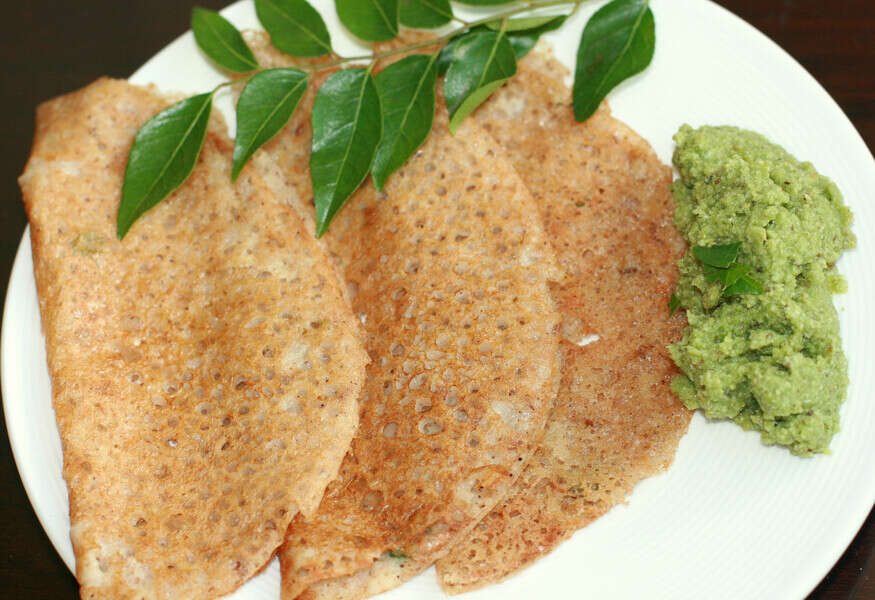
oats_dosa

Ingredients:
  • 1 cup oats
  • 1/4 cup rice flour
  • 1/2 cup semolina/rava
  • 1/4 cup curd
  • 1 medium sized onion chopped
  • 1 green chili
  • 1 tbsp cumin seeds
  • 1 tbsp grated ginger
  • finely chopped coriander
  • salt as required
  • water
Method:
First dry roast the oats for 1-2 minutes in a pan, stirring constantly. Remove the fried oats into a bowl and once cool, blend it into a powder in a blender. Now add semolina, rice flour and curd to the oats. Add green chili, cumin seeds, grated ginger and chopped coriander. Add water and salt as required and mix well. Add more water and mix well until the batter reaches desired consistency for cooking dosa. Cover with a lid and let it stand for 20 minutes.
Check the consistency of batter and add water if required. It should be a little watery, just like you do for a rava dosa. Heat the dosa tawa. Spread a little oil over the hot tawa and sprinkle a little water over it. Immediately pour a ladle full of batter and spread evenly along the tawa moving the ladle in circular motion. Spread a little oil all along the edges of the dosa. Once the bottom of dosa turns brown, remove the dosa carefully. Enjoy hot oats dosa with a red chutney.
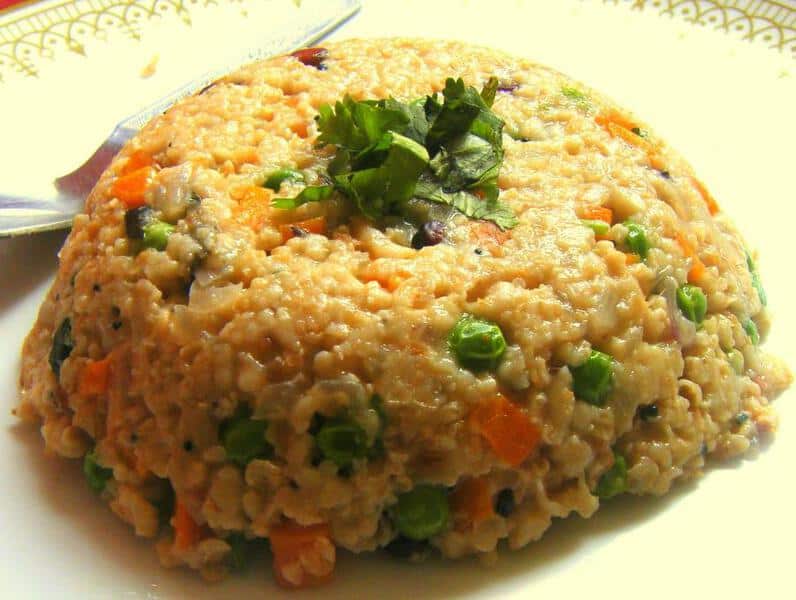
3. Oats Upma:oats upma
Ingredients:
  • 1 cup oats
  • 8-10 finely chopped french beans
  • 1/2 cup fresh green peas
  • 1 medium carrot finely chopped
  • 1 tbsp oil
  • salt to taste
  • 3/4 cup of water
  • 1 tsp mustard seeds
  • 1 tsp cumin seeds
  • 1 tbsp bengal gram
  • 2-3 slit green chilies
  • 1 sprig curry leaves
  • 1 tsp grated ginger
  • 1 medium onion finely chopped

Method:
Roast the oats slightly, stirring constantly. When the oats are crisp, you know that they are roasted enough. Remove this into a bow. In the same pan add oil. Add mustard seeds, curry leaves, bengal gram and cumin seeds. While on medium flame, stir continuously till the bengal gram starts browning. It takes just about 30 seconds. Add slit green chilies, chopped onions and ginger. Saute till the onions turn translucent. Now add green peas, carrot, beans. Add a little salt as per your taste.
Add water and boil till the vegetables are cooked. Now add oats and cook on low flame till the oats are done. Garnish with fresh coriander and enjoy hot.

Friday, 16 January 2015

27 Easy Ways To Eat Healthier

Don’t punish yourself with a cleanse or something equally awful. Just make real food better for you with these yummy substitutions. Here are the 27 most awesome ways to eat healthier.

1.

.

.
.

2.

.

.
.

3.

.

.
.

4.

.

.
.


5.

6.

7.

8.

9.

10.

11.

12.

13.

14.

15.

16.

17.

18.

19.

20.

21.

22.

23.

24.

25.

26.

27.

http://crazyfood.net/27-easy-ways-to-eat-healthier/

Sunday, 30 November 2014

Ethiopian grain a gluten-free alternative to wheat

Teff, a crucial food staple in Ethiopia, is gaining increased interest abroad among health aficionados seeking a nutritious, gluten-free alternative to wheat.


Under a searing midday sun, a herd of cattle circles atop a pile of golden teff, thrashing the wheat-like grain, a method that has been practised by Ethiopian farmers for centuries.
The crop, mostly grown in the Horn of Africa, is a key part of the country's heritage and a crucial food staple, but is also gaining increased interest abroad among health aficionados seeking a nutritious, gluten-free alternative to wheat.
"Ethiopians are proud of the crop because it is almost our identity," said Solomon Chanyalew, director of the Debre Zeyt Agricultural Research Centre, a teff research hub.
"But these days, teff is getting global attention," he said.
Relatively unknown outside of Ethiopia – for now – the cereal is predicted to replace quinoa as the latest global "super-food".
Read: Quinoa may be safe for coeliacs
Ideal for diabetics
But a ban on exports to control price hikes at home has left farmers tied to local consumers, limiting their contribution to growing markets abroad.
The poppy-seed sized grain is renowned for its nutritional qualities. Mineral-rich and high in protein, teff is also a slow-releasing food, ideal for diabetics, and sought after by people with a gluten intolerance, or coeliac disease.
"Teff is not only gluten-free, which is an increasingly important aspect of foods that is being sought out, but it's also incredibly nutritious. Many people consider teff to be a super-food," said Khalid Bomba, CEO of Ethiopia's Agricultural Transformation Agency.
In Ethiopia, teff is used to make injera, a spongy fermented pancake topped with meat or vegetable stew and consumed with an almost religious devotion, often three times a day.
In the West however, where it is touted by celebrity chefs and health-conscious Hollywood stars, the grain is most commonly ground into flour and used to make biscuits, breads, pastas and even teff juice.
Drought-and-flood resistant
It is also a resilient crop; it can grow between sea level and 3 000 metres and is both drought- and flood-resistant, ideal for Ethiopia's dry highlands.
But despite its versatility, Ethiopia's 6.5 million teff farmers struggle to meet local demand – let alone growing demand from abroad – with limited access to seed varieties, fertilisers and modern machinery that would allow for higher yields.
Teff also suffers from a lack of research since it is considered an "orphan crop", unlike global crops like rice, wheat, and maize, which are widely studied and well-funded.
"People don't want to work on teff, basically, it's not paying," said Kebebew Assefa, one of only two full-time teff researchers in Ethiopia.
Yields have increased
Regardless, productivity has climbed to bridge the supply gap, with the introduction of 19 new teff varieties and improved farming techniques.
In the last four years, yields have increased from 1.2 to 1.5 million tonnes per hectare, which Khalid said bodes well.
"The production increases are what gives us the confidence that Ethiopia will be able to compete at a global level when it comes to tapping into the increasing demand from consumers in Europe, in London, or New York or Brisbane," he said.
An estimated two million tonnes per hectare is required to reach export potential.
Price already too high
For now, the ban on exports remains in place to avoid the pitfalls of quinoa in Bolivia, where most people could not afford the staple crop after the surge in global popularity.
The price of teff is already too high for the majority of Ethiopians who earn less than two dollars per day.
But farmers are eager to export their teff, well aware of the higher prices they can fetch.
"I want to sell it abroad because it's going to have a good market and I will earn good money and it will bring good motivation for my work," said Tirunesh Merete, 60, who has been growing teff for nearly four decades.
Neighbouring farmer Amha Abraham said he is keen to make more money, but recognises that local markets need to be fed first.
"If we export teff to other countries then we can get a lot of money, but we must provide first for our country's consumption," he said, standing near a giant pile of golden teff stalks, used for roofing and as cattle feed.
Gluten-free
Until the export ban is lifted, Ethiopian farmers remain excluded from a growing international industry, with teff products appearing on shelves in health food stores across North America and Europe.
"Everybody has started talking about gluten-free," said Rob Roffel, CEO of the Dutch company Consenza, which produces gluten-free foods from teff grown in the Netherlands.
"The demand for gluten-free foods mainly was for coeliacs... but what we see now more and more is other target groups interested in teff flour," he said, adding that his business has grown 30%annually since 2006.
In the meantime, Khalid said he has high hopes for teff.
"If you look at what's happened with quinoa, it's a $150 million market in five years and teff is actually much more nutritious and much more resilient than quinoa," he said.
"So we think there's a much bigger market opportunity for teff."
Read more:
Should more people go gluten-free?
Coeliacs can eat gluten
(Picture:Teff flour from Shutterstock)


Wednesday, 13 August 2014

Moringa leaf powder for...appetite suppression


Feeling constantly hungry can lead to snacking and before you know it, you've put on extra pounds that can be awkward to shift, but by taking Moringa leaf powder, you could suppress your appetite and cut your food intake. The supplement does this by keeping your blood sugar levels constant, which is important as it's the spikes in this that can give you hunger pangs – keeping them steady allows your body to feel full for longer so you don't want to snack so much. Suppressing your appetite isn't the only way that Moringa leaf powder may help you maintain a trim physique – by eating less, your body will break down the fat deposits in it and your metabolism will increase, meaning that your weight shouldn't fluctuate wildly – once you get the fat off, it can stay off. Find out more about how Moringa leaf powder may help your weight control regime and make a purchase by visiting ankhrah.com.
http://www.ankhrah.com/wpsite/health-and-nutrition-videos/

Is Sugar The New Tobacco?

SUGAR TOBACCO
By Elizabeth Svoboda

You already know that eating too much sugar causes your teeth to rot and can lead to diabetes and obesity. But could it also trigger high cholesterol, high blood pressure, heart disease and possibly even cancer? That's the theory of a group of progressive medical researchers who argue that sugar acts as a toxin in the body and is responsible for not only our rising rates of diabetes and obesity but also increasing incidences of heart disease, cancer and other chronic illness. Because sugar is so prevalent in food today -- in obvious items like ice cream, cookies and soda, as well as in "healthy" foods like crackers, energy bars and salad dressings -– experts contend that most people are living in toxic overload.
"Sugar is the biggest public health crisis in the history of the world," says Dr. Robert Lustig, an endocrinologist at the University of California, San Francisco, whose 2009 speech "Sugar: The Bitter Truth" has received more than 2.5 million hits on YouTube. In an opinion paper published earlier this year in the journal Nature, Lustig and colleagues provoked debate when they stated that sugar is so harmful, it should be regulated like alcohol and tobacco. "Every substance of abuse -– cocaine, heroin, you name it -– has required personal or social intervention," says Lustig. "For sugar we have nothing, and my prediction is that we will need both."
At first blush, this antisugar advocacy may seem alarmist. But Lustig and his University of California colleagues argue that sugar is harmful in significant amounts –- not necessarily because it's high in calories but rather because it triggers a toxic chain of reactions in the body that produce harmful fats, hormones and other metabolic by-products. Sugar is found in nearly every food except meat, oil and butter. But there's a big difference between the sugar that occurs naturally in raw, unprocessed foods like fruits, vegetables, milk and whole grains and the type added to prepared or processed foods. Added sugars include every sweetener imaginable: white sugar, brown sugar, corn syrup, high-fructose corn syrup, dextrose, honey, agave nectar. It's these added sugars that experts say are the root cause of our sugar problem because high amounts of them are found in almost every food we eat, most of which are also high in calories and devoid of nutrients. "Nature made sugar hard to get," Lustig and his colleagues wrote in Nature. "Man made it easy."
Among all the different types of sugar, fructose may be the most harmful, many experts believe. Fructose is found naturally in small amounts in fruit, but is also combined with glucose (the other basic sugar molecule) to make nearly every type of commercial sweetener, including table sugar and high-fructose corn syrup. Why is fructose so harmful? "It's unique," says Dr. Miriam Vos, a gastroenterologist at Emory University. "It's primarily metabolized by the liver," so when you eat it, it's processed and then stays in your liver and starts producing harmful blood fats called triglycerides.
Sugars that don't contain fructose, on the other hand, like pure glucose and corn syrup, are processed by the liver and then sent out into the bloodstream, whether you need the fuel or not. Eat enough fructose and build enough triglycerides, and the result can be a fatty liver and insulin resistance -– when the body can't produce enough insulin to break down the sugar you eat.
For years, researchers have known that insulin resistance can lead to weight gain and diabetes. More recently, though, they've also discovered that it can cause heart disease, in part because eating too much sugar suppresses "good" HDL cholesterol. Eating too much sugar of any kind also seems to increase blood pressure, yet the effect is worse when glucose and fructose are consumed together, which is the case with high-fructose corn syrup and white sugar. Some researchers suspect that the effects of sugar on insulin metabolism may even cause cancer or accelerate its growth. "The cancer story is very early," says Lustig. "But we know that sugar drives insulin resistance, and insulin resistance drives cancer." One theory is that the high levels of insulin drive tumor growth, as the hormone already stimulates cancer cells to grow faster in the lab.
Unfortunately, exercise can't entirely save you from the negative effects sugar has on the body. While exercise may improve your cholesterol numbers by a few points, it's usually not enough to bring levels into a healthy range. "If you're a thin, active person, having a diet high in sugar is still harmful," says Vos. If you're an athlete, you may not want to cut out sugar entirely, especially before and during hard workouts. "There's some evidence for the super-athlete that small amounts of fructose are good," says Dr. Richard Johnson, a nephrologist at the University of Colorado, noting that the effect is beneficial only when sugar is consumed in moderate amounts before or after intense activities.
Other experts insist that sugar isn't as much of a threat to anyone -– including those of us who don't exercise intensely –- as Lustig and others have claimed.
Dr. David Katz, director of the Yale Prevention Research Center, says that while too much sugar isn't great for us, Lustig's dismissal of it as "poison" goes too far, pointing out that our bodies manufacture it naturally as an energy source. "The notion that sugar is toxic is silly," says Katz. "You can show dreadful effects of a high dose, but so what?" He's also skeptical of experts who push elimination of sugar to the exclusion of all else. "This is exactly the sort of dietary boondoggle we've been bogged down in for decades. We fell in love with low-fat; we fell in love with low-carb. If we fall in love with low-sugar, we won't improve our overall nutrition. It's a classic missing-the-forest-for-a-single-tree scenario."
Though Katz does agree that most Americans probably eat too much sugar, he doesn't recommend giving up the sweet stuff entirely because that can lead to food bingeing. Instead, he and most nutritionists advise learning to keep your quantities under control. For men, this means limiting yourself to nine teaspoons of added sugar per day and six for women (a can of cola has eight) if you want to meet the American Heart Association's recommendation. To gauge that limit, start scanning the nutrition labels of the packaged products you eat every day for at least one week. Add up your daily intake, keeping in mind that four grams of sugar on a food label is equivalent to one teaspoon of sugar. If you exceed the recommended limit on a regular basis -– and most of us do -– start by substituting lower-sugar options for foods that shouldn't taste sweet, like crackers and salad dressings. Ditch all sugar-sweetened drinks, like soda and even fruit juice, which packs a condensed amount of fructose without the fiber or other healthy nutrients of real fruit. Finally, prioritize eating whole, unpackaged foods, which don't contain added sugars.

10 Ways to Ditch Your Cravings for Sugar, Salt, and Fats

According to a recent article in the New York Times, "Food Corporations Turn to Chefs in a Quest for Healthy Flavor," Big Food companies like PepsiCo, Kellogg's, and even fast food giants like Taco Bell are changing their ways in response to the increasing public demand for healthier food options. To improve their image as healthy food manufacturers, Big Food corporations have called upon top chefs to help them create healthy menu makeovers, infusing real, fresh, whole food into old recipe favorites.
Why is this happening now? Intense pressure brought on by politicians and their constituents (you and me!) has given these food manufacturers no choice but to respond to the public outcry for healthier food. It's no longer enough for these companies to earn a profit by selling food that tastes good. People are beginning to use the power of the pocketbook to show these companies that the food they sell must also be nutritious.
That's because people everywhere are waking up. They are beginning to see the dangers of genetically-modified ingredients and all the sugar, salt, and fats hidden in our food supply. From fancy restaurants to fast food chains, chefs are catching on that people want their food to make them feel good, not just while they are eating it but hours, days, and years afterward.
Really, this news shouldn't make the headlines. This is common sense! Paying for food that makes us sick is as crazy as shooting ourselves in the foot. It just doesn't make sense.
Big Food is finally getting the message and getting on board.
But remember, no processed or fast food option will ever be better than a healthy home-cooked meal. The best way to ensure you are eating the highest quality, most nutritious food possible is to prepare your own food in your own kitchen. We are all chefs. You don't have to be trained at Le Cordon Bleu to know your way around a kitchen. You just need a little knowledge, some imagination, and a sense of adventure.
A desire for real food is a fundamental part of our basic biological blueprint. Given the chance, our taste receptors will naturally gravitate toward the inherent sweetness found in vegetables, fruits, and even nuts and seeds.
So, how do you reprogram your taste buds to ditch the cravings for sugar, salt, and fats? You can start by eating real, fresh, whole foods. Avoid fake, commercialized foods that come in convenience packages or are made in a lab.
Here are 10 more tips to get you excited about ditching the sugar, salt, and fats:
  1. Sauté or roast your veggies to bring out their natural sweetness. Properly searing your chicken or meat brings out the inherent sweetness by way of the Maillard reaction. This is a fancy name for what happens when you create that nice, brown crust on your meat.
  2. Play with herbs like cilantro, parsley, dill, basil, and oregano to add flavor and phytonutrients! Finish a meal by adding fresh herbs before plating or serving. This last-minute addition kicks the flavor up a notch!
  3. Healthy fats found in avocado, coconut, and tahini not only increase the flavor of your meal, they also add that creamy, luscious texture found in many rich foods.
  4. Try creating a savory, umami (Japanese for "delicious") flavor. Add moderate amounts of tamari, umeboshi plum paste, balsamic vinegar, tomato paste, dried mushroom, or sea vegetables to your next stew, soup, sauce, or stir-fry.
  5. Cinnamon, allspice, nutmeg, clove, ginger, and even cayenne or chipotle pepper powder are all extremely flavorful additions to a meal. Spices like these excite your taste buds and grab your attention. This is helpful, because, as studies show, when we are focused on actually tasting our food rather than mindlessly gobbling it up, we actually need less food to feel satisfied.
  6. Befriend some kitchen must-haves like real vanilla extract or vanilla bean or coconut butter. Or use common, every-day foods like lemons in some creative ways. For example, use lemon zest to add real zing to any meal!
  7. For the most flavor, eat seasonally and locally. Canned or packaged foods or foods that have traveled great distances in the back of a truck just can't compare to the succulence of a fresh piece of locally grown fruit.
  8. Check your hydration. Digestion starts in your mouth with your saliva, which helps us taste all the magnificent flavor in food. If you are dehydrated and not producing enough saliva, you won't really be able to enjoy your food.
  9. Check your medications. Believe it or not, most medications interfere with the body's ability to taste and smell. Some of them can even create an unpleasant metallic taste in the mouth. Wondering how you might decrease the number of pills you take? Learn more about functional medicine.
  10. Got nutrition? Nutrient deficiency is an important cause of improper taste perception. A lack of certain vitamins and minerals can markedly impair your ability to smell and taste food. Most Americans have several nutrient deficiencies, but there is one in particular that can especially keep you from enjoying your next meal: zinc. Try adding foods like oysters, pecans, sunflower seeds, and lentils to increase your daily intake of this important mineral.
Now I'd like to hear from you...
What has helped you replace your cravings for sugar, salt, and fats?
What are some of your favorite healthy meals that you like to cook at home?
To your good health,
Mark Hyman, MD